Sewer Line Repair in Fort Lauderdale
Fort Lauderdale has roughly 67,000 housing units built before 1980, more than any other city in Broward, and a median year built of 1972. That places most of the city's single-family stock inside the cast iron era, and it is why so much sewer line repair work here is pipe condition rather than blockage.
- Victoria Park
- Rio Vista
- Coral Ridge
- Sailboat Bend
- Croissant Park
- Poinsettia Heights
- Lauderdale Isles
By volume, Fort Lauderdale is the centre of Broward’s cast iron problem. U.S. Census ACS 2024 five-year data, table B25034, puts the city at 101,234 total housing units with a median year built of 1972, of which 66.3% predate 1980 and 44.6% predate 1970. In absolute terms that is about 67,000 units built before PVC became standard in Florida residential construction — the largest such stock in the county by a wide margin.
What that means for a specific house
PVC became standard here in the late 1970s, so year built around 1975 is the practical dividing line. A Victoria Park or Rio Vista house from the 1950s or 1960s almost certainly has original cast iron under the slab. A house in the newer western sections may not.
The Cast Iron Soil Pipe Institute rates cast iron at 50 to 75 years of service life. In South Florida’s sandy fill and high water table, practice runs closer to 40 to 50. A 1962 house is at 64 years. A 1972 house is at 54.
The local factors that shorten it further
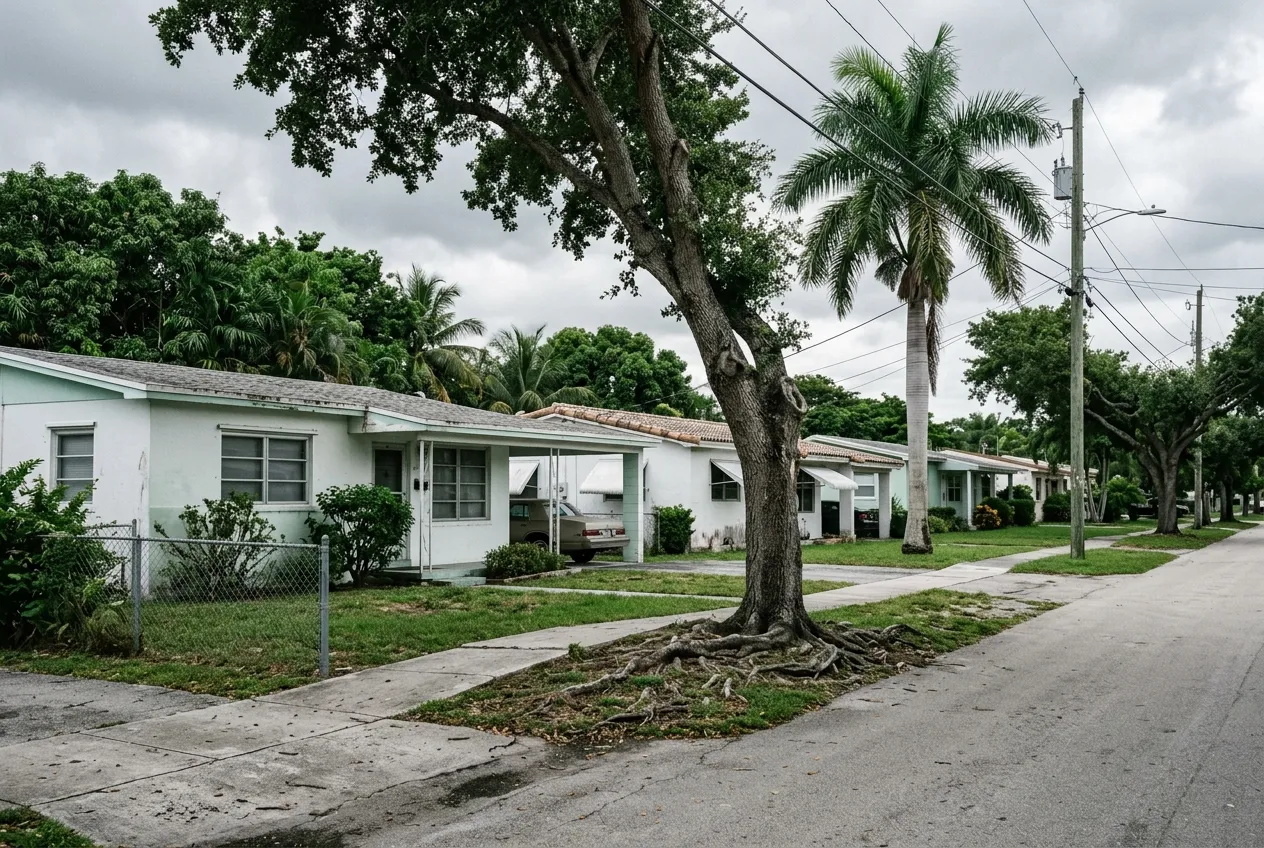
Fort Lauderdale’s geography works against buried iron in ways inland cities do not share. Much of the city sits close to sea level with a high water table, and the eastern neighbourhoods — Rio Vista, Coral Ridge, Lauderdale Isles — are built on fill along canals. Permanently damp, well-aerated sand corrodes pipe from the outside along its whole length rather than at isolated wet spots.
Florida’s Building Code recognises the condition explicitly: its clause for filled or unstable ground sets the conforming materials for a building sewer, listing ABS, cast iron, copper or copper-alloy, PVC and PP. That clause is written for exactly this ground.
What we see most often here
| Finding | Typical setting |
|---|---|
| Channelled cast iron — bottom corroded away | Pre-1970 slab homes across the eastern neighbourhoods |
| Root intrusion at joints | Older streets with mature live oak, ficus and black olive |
| Bellies from settlement | Fill sections near canals and the New River |
| Storm-linked backups | Lines already cracked, taking groundwater in heavy rain |
Before any quote
Have the line camera-inspected with a surface locate, so the defect gets a distance and a depth marked on the ground, and keep the recorded footage. On a city with this much old pipe, “the line looks rusty” describes almost every house here and settles nothing. What matters is whether the camera can name a defect — a crack, an offset, a belly, channelling, roots — and say where it is.
If the marked position sits near the street, the next call is to establish whose responsibility it is before anyone digs, since work in public right-of-way brings Broward County permit and restoration requirements that do not apply on the private side.
“We mark the defect on the ground with the depth before we quote. In this city the pipe is old everywhere — what matters is where it has actually failed.”
To have a Fort Lauderdale line scoped and located, request a free quote.
Related services
- Cast Iron Pipe Replacement for South Florida HomesCast iron drain replacement swaps original 1960s and 1970s pipe for PVC to current Flori…
- How Long Do Cast Iron Pipes Last? Service Life in Florida HomesHow long cast iron pipes last depends on the ground they sit in. The Cast Iron Soil Pipe…
- Sewer Camera Inspection in Broward CountyA sewer camera inspection sends a camera on a push rod along the line from a cleanout wh…
- Broken Sewer Line: The Signs, and What They Look Like in FloridaA broken sewer line shows itself through repeat backups, a persistent sewer smell at flo…